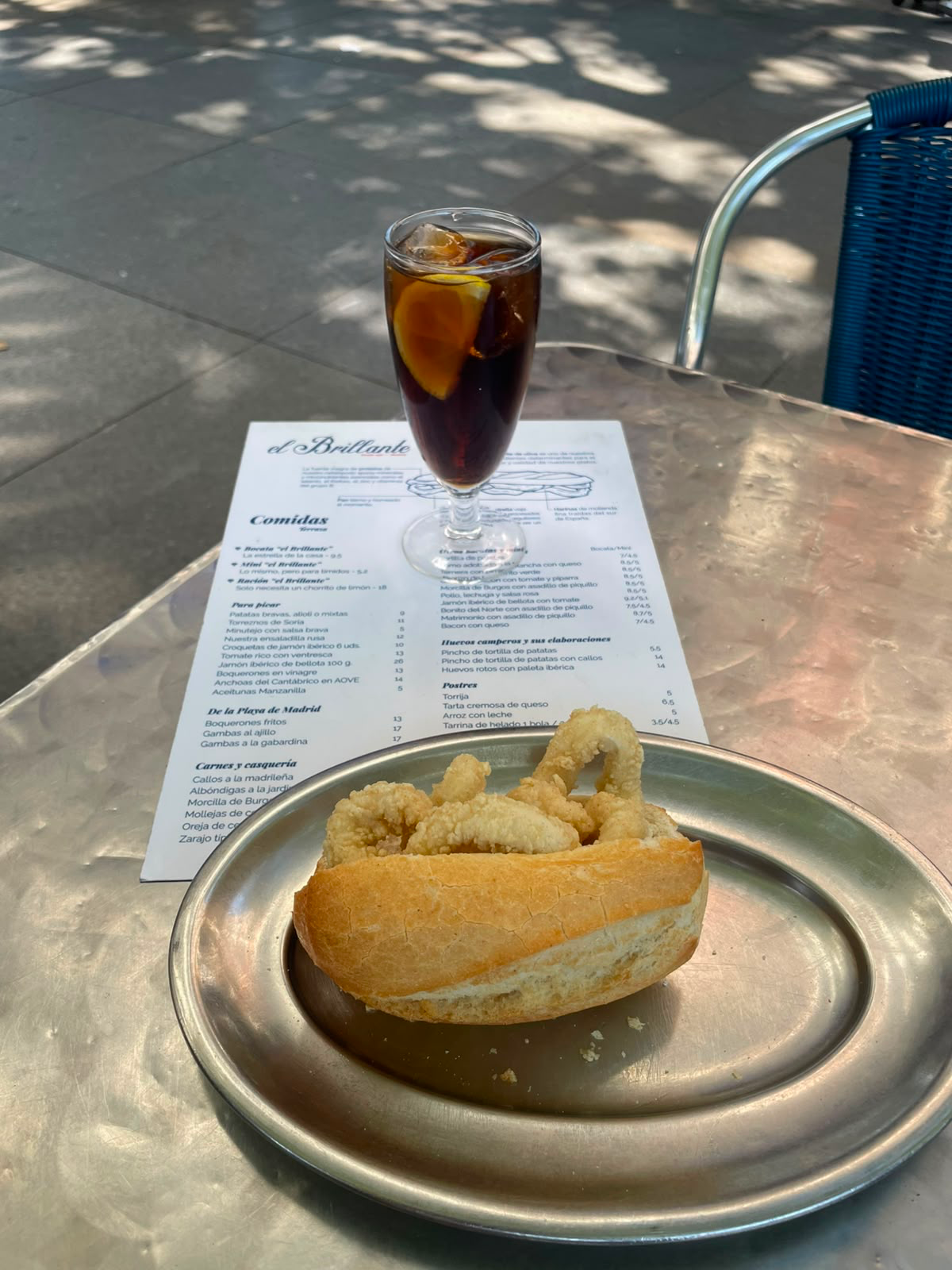
A squid bocata and a vermouth, please
Notes from my first vipassana — a ten-day meditation and silence retreat
Introduction
Life hands you experiences, and it is up to you to decide whether you will remember them with joy and love or whether they will be memories that are hard to process.
For the last 10 days I woke up at 4 a.m., not out of anxiety, but by choice. As soon as I woke I took a quick shower, and that is where I discovered something: despite being in total silence, there was a perpetual playlist running in my head. At first I thought the songs were completely random, and after a few days I realised they carried deep messages that I would be processing in the time to come.
The repertoire ran from Juan Gabriel to David Bowie, from Banda MS to Cameron Winter, by way of a heavy dose of Little Jesus, Julieta Venegas and, inevitably, Bad Bunny.
Today I want to tell you how I lived through a 10-day meditation course, in silence. That silence did not stop my mind from assembling, entirely unconsciously, a constant stream of songs — which I danced to, laughed at, cried to, got distracted by and enjoyed. I will tell you about some of the moments that will stay with me for the rest of my life.
You can find the playlist of these songs here.
“God is real,God is realI’m not kidding,God is actually realI’m not kidding this timeI think God is actually for realGod is real,God is actually realGod is real,I wouldn’t joke about thisI’m not kidding this time”
$0 Cameron WinterContents
Introduction
How did I get here?
Luis Daniel Beltrán
Ramón Basanta
FAQs
The beginning
Sensitivity
Creativity
Dreams
The stars
The work
Pain
Friendship
Family
The conclusion
The bocata and the vermouth
How did I get here?
Not long ago I understood that my path of self-knowledge began around the time I was 5 or 6 years old. That was when I discovered that I could think; my uncles and first teachers showed me the first surfaces of meditation, and my mother began to dig into the labyrinth of my mind with her psychoanalytic gifts. In the piece “This is not spiritual advice” I tell that story in more detail.
Now I want to tell you about two friends who were instrumental in my living this experience.
Luis Daniel Beltrán
Dani is one of those people who simply radiates good energy. He radiates so much good energy that his Uber passenger rating is probably 5 out of 5 stars — Ted Lasso is not the only one who can pull that off. I met Dani in 2021, when we recorded a podcast at Espacio Cripto; we invited him because he was the person who introduced Lalo (my co-founder at Espacio) to the whole world of blockchain. We kept a cordial relationship and, when we raised money to launch Bando, he was one of the first people we pitched. In that first pitch he told us: “This is amazing, and I’ll invest in whatever you two do.” I remember that call perfectly, almost like a photograph of the desk I was working at in the Jerónimos neighbourhood of Madrid.
In 2024 Dani was promoted to the rank of teacher and friend on my personal scale. He visited Madrid for a few days and for the first time we spent several hours together in person. That is where I discovered a deep and fascinating side of Dani. I understood that, had he lived during the Middle Ages, his life would have taken one of these 3 paths:
1. He would have done something worthy enough to be canonised.
2. The Inquisition would have hunted him to death.
3. He would have died in an alchemy experiment.
A few months before starting my 7-week trip through Europe I called him and said: “Dani, I want to do a silent retreat, what do you recommend?” He simply answered: “Vipassana, that’s what I recommend.” I signed up for the retreat right then.
I also told him that a few weeks before setting off on my summer adventure I was going to do a therapy session with a high dose of psilocybin 🍄. Dani answered me with a perfect analogy that I did not understand at the time and that even struck me as an exaggeration:
“Imagine your consciousness is a mountain with a beautiful forest at the summit. Substances like psilocybin are as if a helicopter picked you up at your house, flew you to that forest, dropped you there, and gave you a couple of hours to explore that incredible place. Then that same helicopter picks you up and takes you home.
Vipassana is like packing a rucksack and climbing the mountain all the way to the summit. It is a path of hard work, much longer; in the end you arrive at the same place but with far more information and far less distortion. It is climbing without shortcuts, with the chance of getting to know that great forest in much more depth.”
After doing the psilocybin therapy I thought, “Dani is exaggerating. How could it be possible to reach the same place as what I have just experienced?” For the first 3 to 5 days of the retreat I kept thinking that Dani had clearly overstated his analogy. From day 7 onwards I understood. He is right. I did reach the same sensations of love, deep creativity, crystalline clarity; only without such a strong psychedelic distortion of the present moment. The price is that you have to invest 30 times more time (I worked it out) and an unquantifiable amount more effort.
Dani is a wise man.
Ramón Basanta
Ramón is the founder of Atma, the yoga and meditation studio conveniently located a 3-minute walk from my house. I discovered Atma on a random night in 2025 when I was having a beer at one of the bars around the Roma. Someone I had just met pointed at the Atma building and said: “They give really cool meditations in there.” I took that as a sign and started going to yoga classes at Atma.
From the start, the asana (posture) classes struck me as very good. Honestly, it annoyed me that they charged 50 MXN to rent a mat. Then I understood that they were probably doing that as a filter, so that more serious practitioners would come to Atma. That weekend I bought the first yoga mat of my life.
Later Pau went to one of the meditation sessions with Ramón and told me: “You have to go to these meditations, you’re going to love them.” That was profoundly right. These days, if I am in Mexico City, you will find me at Atma in Ramón’s classes.
Those sessions inspired me to do a 200-hour yoga certification, which I wholeheartedly recommend to anyone interested in the philosophy, the physical practice and the meditation. That is where Ramón became my teacher and friend; I think what sealed the friendship was paying for the certification in bitcoin.
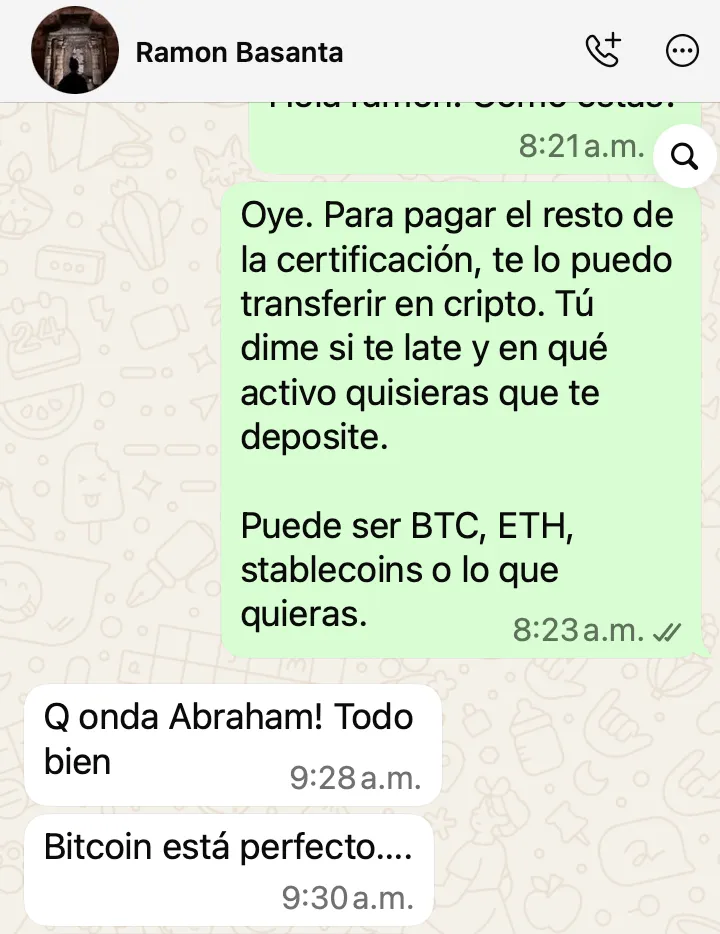
I told Ramón about my upcoming vipassana adventure and he gave me a couple of preparatory instructions. Today, having had the time to process everything I lived through in the past days, I understand that the teachings Ramón has shared with me over the last few years were instrumental in letting me enjoy this experience to the fullest. Although it is true that you can take on this adventure with no previous meditation practice and zero knowledge of Buddhist or Hindu philosophical concepts, arriving with some context in my rucksack amplified my path.
The best way I have of putting into words what Ramón’s help has meant is to recall what I said to him on the last day of the certification he taught.
My path of spiritual knowledge had been solitary and self-taught until a year ago, for many reasons worthy of another essay. My meditation practice began, on and off, around 10 years ago, and it came out of my own research and curiosity. It involved books, podcasts, talks, apps and many experiments. I genuinely thought it was a solitary path, above all because I do not subscribe to the idea that the West has gurus with deep answers. Today I understand that on this side there are very few enlightened people (I really believe there are none, but absolutes always lie), and yet there are individuals who have explored regions of consciousness that were unexplored to me. That is where I said to Ramón:
“For me you have been like the forest ranger of consciousness. Someone who diligently tends this forest, whom you run into on your own exploration and who tells you ‘If you want to reach this or that place, the fastest way is over there.’ Then it is up to each person to explore that path and form their own judgement about whether it was true or whether the directions were false. I am on that path of exploration.”
That is how I got here.
“This is Ground Control to Major TomYou’ve really made the gradeAnd the papers want to know whose shirts you wearNow it’s time to leave the capsule if you dare”
Space Oddity David BowieFAQs
I know you probably have a good number of questions about the practical side of the retreat; I will share a brief set of FAQs and then tell you the deeper reflections I am able to recall today. I will be as brief as possible in this section, because it is not the focus of this piece and at the same time I think this context matters. What you will read is my perspective, and every answer has far more depth to it, which I invite you to explore.
-
What is vipassana?
It is the meditation practice the Buddha discovered 2,500 years ago in order to attain total liberation. On reaching the highest degree of enlightenment the Buddha devoted the following 45 years of his life to sharing and spreading this practice to anyone willing to learn it. After the Buddha died the practice was diluted little by little until it had almost entirely disappeared 450 years after his death. Legend has it that a group of devoted monks in Burma (today Myanmar) kept the technique alive and passed it on tirelessly from teacher to disciple for centuries. It was written that 2,500 years after the Buddha’s death vipassana would spread across the planet, for the good of humanity. -
Do I have to be a Buddhist or religious to practise vipassana?
No, the teachings and practices are entirely secular. The person who began to spread this technique was S. N. Goenka and he was not affiliated with any religion. Throughout the 10 days of the retreat they reaffirm constantly that anyone — Catholic, Jewish, Hindu, Maradonist, whatever — can practise vipassana. -
What is the goal?
To see clearly how your inner experience works and to stop reacting to it automatically. That means observing your sensations, emotions, thoughts or any impulse you have with attention, understanding that they appear and disappear constantly, so as to finally attain total equanimity towards them. -
What is the practice like?
Basically it is sitting in silence and directing your attention around the body to see how sensations emerge and disappear. There is no visualisation, no chanting of mantras, no manifesting, no praying to deities, or any other kind of meditation you might think of. -
Where was it?
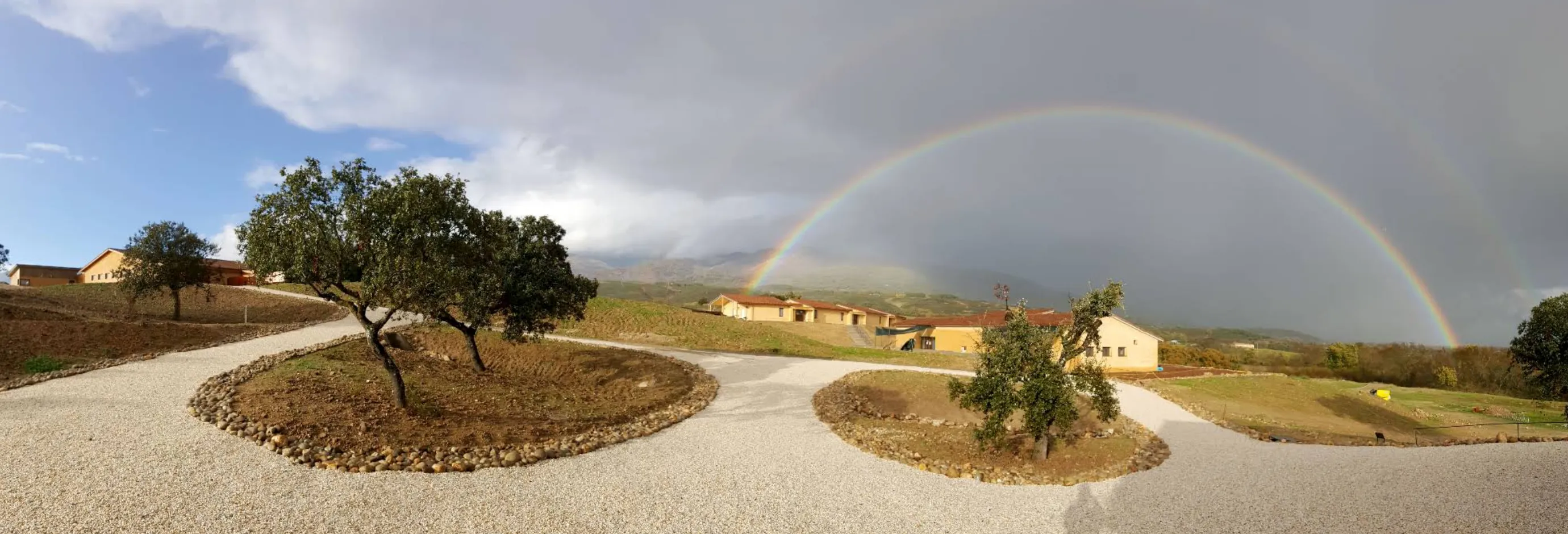
I did it at Dhamma Sacca, the meditation centre 2 hours from Madrid, very close to Candeleda. It is a beautiful place designed specifically to house and run vipassana retreats. The centre can host more than 110 meditators at once and more than 20 volunteers. In my case, there were around 100 meditators on the retreat with me. The women’s and men’s quarters are completely separate and there is no interaction with the opposite sex during the 10 days.
-
What does it mean that you are in silence?
For the 10 days you subscribe to a concept called noble silence. That means suspending almost entirely any communication with the people around you in order to maximise the time you spend looking inward. It means not speaking, not making eye contact with the people around you, not communicating by gestures, notes, and so on. You can only speak to the team of volunteers if you need something and, more importantly, to the teacher who is present during the meditation sessions. -
Can you bring books, your phone, or anything to write with?
You are advised not to bring anything to write or read. When the retreat begins they take away your phone, your computer and your car keys. -
What are the timings?
- 4:00 the gong sounds to wake up.
- 4:30–6:30 meditation in the meditation hall or in your room
- 6:30–8:00 breakfast and rest
- 8:00–9:00 compulsory group meditation in the hall
- 9:00–11:00 meditation in the hall or in your room.
- 11:00–12:00 main meal, everything is vegetarian for 10 days
- 12:00–13:00 rest; a chance to speak briefly with the teacher. A nap here is essential to keep your energy up
- 13:00–14:30 meditation in the hall or in your room
- 14:30–15:30 compulsory group meditation
- 15:30–17:00 meditation in the hall or in your room
- 17:00–18:00 light meal, which is just a piece of fruit.
- 18:00–19:00 compulsory group meditation
- 19:00–20:15 Goenka’s talk on the practice and the philosophy behind it. Basically a podcast about the philosophy of vipassana.
- 20:15–21:00 final meditation
- 21:00–21:30 a chance to ask the teacher questions.
- 21:30 back to the rooms; lights out shortly after.
In total, it comes to around 10–11 hours of meditation a day. I meditated between 6 and 8 hours a day; generally, in the non-compulsory sessions I did sittings of around 40 minutes and then 15 minutes to stretch my legs and walk.
-
What did I eat?
For the 10 days you eat entirely vegetarian, food cooked by a group of volunteers. It is not an incredible culinary experience, but it is quite revealing. For example, on day 4 I understood that I love bread and butter. It does not have to be good bread or good butter, the combination alone is sublime. -
How much does it cost?
Nothing, it is completely free. At the end of the retreat you are encouraged to donate whatever you can. The cost of your stay and your food is covered entirely by previous donors. There is also a team of around 15 volunteers and 2 teachers who charge nothing for their service. -
Where can I do a vipassana?
There are 270 vipassana centres in the world following this tradition; they run retreats of 3, 10, 20 and more days, and they charge nothing for them. Here you can find the full list.
In Mexico there is a centre in Valle de Bravo, and here you can see the upcoming retreats. -
Where can I learn more about vipassana?
On this site you can find plenty of information to get started.
The beginning
Over these 10 days I had deep realisations, some of the most enriching meditation sessions of my life, dreams verging on the psychedelic and many other experiences. When you spend that much time meditating, your brain changes, your spirit emerges and your body yields the fight. For me it is like touching a familiar chord that had been out of reach, because I did not know the way to it. Writing this today I feel a deep happiness and gratitude. The main message is that we have a life full of abundance and it is up to us to make the most of it. Let me tell you my realisations.
“Estoy caminando, conciencia y libertadCamino despiertoCamino despiertoAlgo está cambiando en míPuedo verlo”
Algo Está Cambiando Bomba EstéreoSensitivity
I am a naturally sensitive person. All my life I have had a high capacity to connect with my emotions, and in recent years that has been amplified. Never to this degree. After these 10 days, the emotions that emerge from me are deeper and purer. It is as if the circuit connecting my sensory body to my emotional body were now closer together, so there is less resistance in the communication between those two poles. It is something I had never experienced.
Creativity
One of the most surprising things about this experience was the creative power that came out of me. It was completely unexpected. I understood that it was a flow of energy I could not control; I was simply a witness to its powerful current.
One of the rules was not to write anything during those 10 days. At first that felt like a shame, because the creative flow was so powerful that not making use of it seemed like a waste. Regardless, I gave myself over to the current and enjoyed it completely.
Over those days I got clarity on the path I want to take as an entrepreneur. I began building what I titled “The manifesto for enjoyment”, a text soon to be published. A couple of letters to write and send revealed themselves to me. I began writing this collection of experiences in my mind. I built an imaginary playlist with the songs that kept me company. All of this, and no way to document it, what a shame…
Then I understood. Another blow of clarity arrived. It is not a shame to lack the tools to document the experience; in truth it is a great blessing. For a long time I thought a creative process was a structured, parameterised sequence leading to the act of creating. Almost like a recipe. The truth is that today I understand creativity as something entirely opposite to a process. Today I see that everything we could create in this life already exists, it is just that we do not always have the conduits to access those creations and materialise them. Those days were like a cheat code for seeing much of what I can create. But where did that information go?
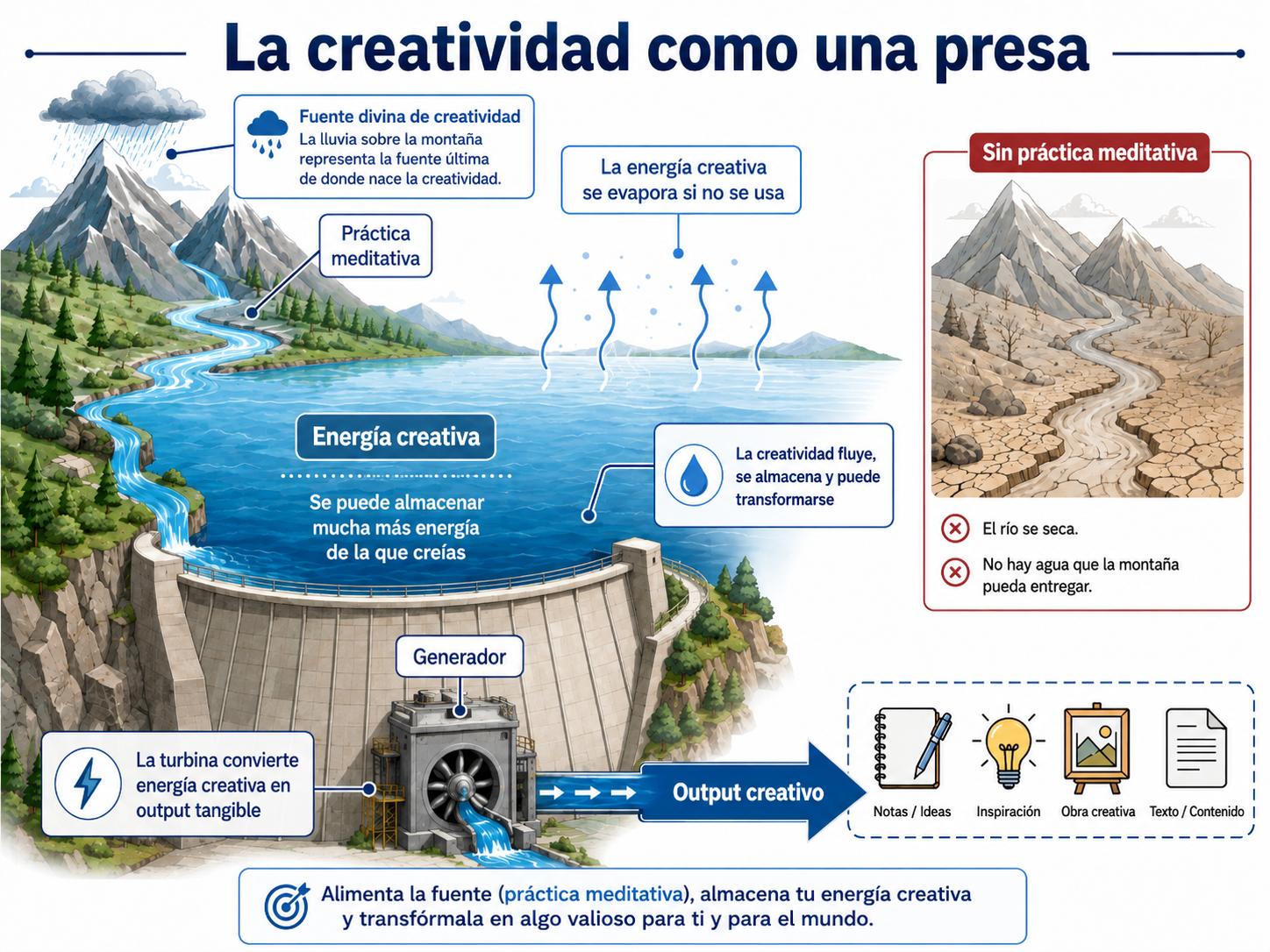
After processing how this massive deployment of my creative energy worked, I arrived at an analogy good and simple enough. Creativity is an energy that flows, has inputs and outputs, and can be stored; like any other kind of energy. The best way I have of thinking about this kind of energy is to picture a dam, where instead of storing water it stores creative energy. I used to think this dam had a low capacity, let us say it could only store 1 million litres. That is why it was essential that, as soon as creativity arrived and filled the dam a little, I was obliged to switch on the generator and use that water to produce a specific tangible output. That approach is wrong, because it sees creativity as a dragon to be chased incessantly and obsessively.
During those days when I felt creative energy coming into me but there was no way to get it out, I understood that this energy does not simply arrive and disappear — there really is an opportunity to store it and hold it latent, waiting to be summoned. It is as if I realised that the dam does not have a capacity of 1 million litres; its real capacity is billions of litres and it is impossible to grasp the true volume it can hold. Like any open-air dam, the water evaporates if it is not used to generate a tangible output. Creative energy also degrades and evaporates if it is not used. Now, what is the way to be able to summon that energy, refill the dam constantly and have tangible outputs consistently?
For me that key is maintaining a spiritual practice with high discipline and firm determination. Today I know that the potential of my creative energy is at an all-time high and I do not know what tangible output will come out of that potential. Honestly, I do not care to know what all of this materialises into. All I know is that it will be magnificent, and whatever comes will be met with total love and surrender. For that, I hold to a commitment to a ceaseless meditative practice, as I have for the past two years.
On that note, my friend Chat helped me make an infographic that sums up my analogy.
“Siento que este es el mejor momentoClima fresco, día perfectoCero nubes en el cieloUna melodía suena en mi celularHay posibilidades infinitas”
Copa del Mundo Little JesusDreams
What matters more when you sleep: dreaming or resting?
What is more romantic, dreaming about someone or that person being your last thought before sleep?
Which would you rather: sleep and never wake, or sleep and never be able to dream again?
These are all questions without answers, like dreams, which are encrypted information that often is not worth decoding. Over those days the dreams I had were a combination of a powerful psychedelic trip and a path of total lucidity and presence. As a new friend said to me when the silence ended: “Seriously wild, bro 🤙🏻.”
Just as there was a storing-up of creative power during those days, there was also an oneiric outpouring I had never experienced. It all began on the night of the first day with a dream that was basically a one-to-one conversation with my dad, ending in a long, deep hug, surrounded by tears. I woke from that dream crying and with a profound feeling of love. It was quite disconcerting, because I am someone with big dreams but who does not dream often at night. That was the beginning.
Everything intensified from the third day. The rhythm of the days is designed so that you take a 1-hour nap right after the meal. Every day I came to that nap with deep physical and mental exhaustion. Waking at 4 a.m. and having meditated 6 hours by 11:00 is an intense and very tiring stretch; that is excellent for amplifying dreams of the “seriously wild, bro 🤙🏻” variety.
Those dreams were a beautiful, powerful and sublime eruption of my unconscious. Like those images of giant volcanoes with rivers of lava pouring out, flowing with enormous energy and beauty and destroying nothing in their path. Something that had never happened to me was having a dream where I controlled the dialogue, did not know I was asleep, and my senses moved between knowing I was lying in a bed in Candeleda and lying on a sofa in a dream.
“I took a heavenly ride through our silenceI knew the moment had arrivedFor killing the past and coming back to life”
Coming Back To Life Pink FloydThe stars
Every day began at 4:00 a.m. when the first gong sounded to wake us; that was the signal to leave the realm of psychedelic dreams and enter the inner world. My routine was simple: wake up slightly dazed by the hour, take a quick shower (without washing my hair, so as not to get ill), get dressed and head to the meditation hall. At 4:25 the second gong of the day sounded, warning that the first meditation session would begin in 5 minutes. Between 4:20 and 4:30 were some of the best moments of the day, for a very simple reason. The stars.
The sky at Dhamma Sacca at 4:20 in the morning is one of the most magical things I have seen in my life. That ceiling of flickering lights was amplified by an altered state of consciousness after days of eating little, not speaking and meditating 8 hours a day. For many years I have had a great fascination with the stars — from the scientific understanding of them, to how they are represented in the world of art, to what they mean in mythology and much more. I remember that during my first years at university I used to think “if one day you can’t see the stars, you just have to look higher.” That is generally true. At Dhamma Sacca you only had to look at the horizon to take in a cosmic spectacle.
I perceived the stars as moving. One night I counted 5 shooting lights in 10 minutes. I felt I could see nebulae up there. These celestial beings confirmed another of the arguments I am prepared to defend to the death: my world is made for me, just as your world is made entirely for you. We have the privilege of coinciding, of our universes converging for a finite space and time. So let us make the most of that time.
The stars prove this point for me because they are a sensory spectacle that goes beyond the physical plane. Seeing them and sharing them with every inhabitant of this planet is a sensitive experience. It is very unlikely that we will ever reach a star other than the sun, so what do they exist for? They are simply a cosmic phenomenon over which we have no control, like everything in life. If they are here, it is simply for us to enjoy them. To make our lives and our nights a more pleasant place. To enjoy a night-time show. To light my way from my room to the meditation hall.
They are made for me. For you.
“Hoy que tú estás conmigoYo no sé si está pasando el tiempo o tú lo has detenidoAsí quiero estar por siempreAprovecho que estas tú conmigoTe doy gracias por cada momento de mi vivirTú cuando mires para el cieloPor cada estrella que aparezca amor es un “te quiero””
Abrázame Muy Fuerte Juan GabrielThe work
Before starting these 10 days I was talking with several friends, and the factor that made the biggest impression was the fact of spending 10 days in silence. I was not worried about that; I was more struck by what Dani and Ramón were warning me about: you are going there to work. I really did not understand what they meant by the term “work” in this context. It became completely clear by the end of the first day.
Throughout the course the days ran to a demanding and quite strict schedule, with the aim of maximising your work as much as possible. Work means sitting down, not moving for as long as possible, and doing the vipassana practice with firm determination. This meditation technique has the particularity of being centred on observing the sensations of the body and seeking not to react to them. I felt very capable of doing this after several years of meditating; these days helped me see clearly how much of an almost infinite road I still have ahead of me.
The 4:30 to 6:30 meditation was generally quite enjoyable — your body is fresh enough to concentrate and to move very little for those two hours. The problems started around 10:00. When you hold a seated posture for more than 40 minutes your mind starts to complain and shout louder and louder, and those shouts are projected onto your body as pain. It is not just any pain, it is the deepest physical pain I have experienced in my life. In the face of all that, the practice tells you: observe the pain and do not react. It sounds stupid — if the only thing you have to do to stop the pain is move, why not do it? Today I understand that behind the pain is love.
“Se preguntarán qué es lo que hacemos cantándole al amorMientras el mundo se va al carajoNi más ni menos que, nuestro trabajoNuestro trabajoCada cual sabrá, qué hacer cuando el barco se hundaCon el casco abierto por el impacto de la rocaNi más ni menos que, lo que le tocaLo que le toca”
Nuestro trabajo / Los puentes Jorge DrexlerPain
“Pain is inevitable, suffering is optional.” That is a phrase that has been wandering through my life over the last few months; my friend Borja said it to me in one of our weekly conversations where we talk for hours on the phone. I used to think that sentence made a lot of sense when the pain is not physical, when it is a little more abstract. When I have brought it up at dinners or gatherings of any kind, many people tell me it is a typical Stoic approach; hearing that was a little disconcerting for me, because I think it is somewhat incomplete to understand it only through Stoicism. Today I have a little more clarity on how pain is inevitable and suffering is entirely optional.
One of the concepts from vipassana that impressed itself on me most was Adhitthana, which means “firm determination”. It is a foundational element both of the whole philosophical scaffolding of the practice and of the 10 days you spend meditating for hours. From day 3 or 4 (the timings are blurry in memory) the adhitthana meditations begin, which basically means you will sit for at least an hour with the intention of doing vipassana and not moving your body. Not a single muscle. That means sitting in your favourite meditation posture, for at least 60 minutes, navigating the inner sea, which can be as terrifying as the Bering Sea in a storm or as soft and warm as the Mediterranean in August. That sailing is as painful as it is comforting, and the moment you reach port the feeling is one of complete, absolute happiness.
When the adhitthana meditations began my body had already been wearing down for several days, spending hours sitting in the same posture. My mind was in an eroded state, where the wear had chiselled it little by little and I could begin to see the sculpture underneath the block of marble that is our interior. At this point I could sit for 30 to 40 minutes without any pain and with a more or less stable mind. The problem started at minute 31. That is where I began to feel some of the deepest physical pain I have ever had. I say this from a position where I know that the physical pain we feel as men is often overblown, where the man-flu-versus-childbirth meme describes perfectly what I mean. This was deep, real physical pain, as real as the projections our minds generate every day. So, it was an illusion.
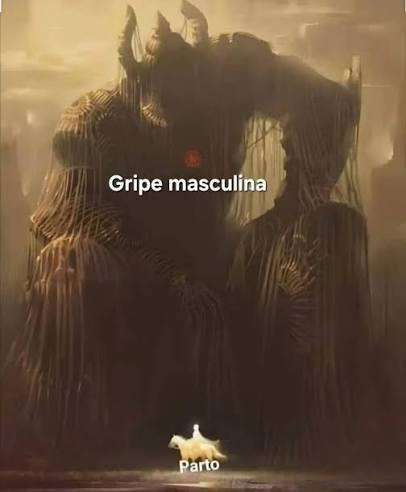
From one moment to the next everything changed. In an instant the pain in my knees and upper back was completely unbearable, but firm determination steps in and the only thing to do is observe that pain and not react to it. Simply acknowledge it through attention. Within a second the pain transformed into a sensation of energy being released that is very hard to describe; the best analogy is that first gulp of air after a long time underwater. The desperation of not knowing whether I would manage to get through it is completely anaesthetised by a deep inhalation that brings a profound peace. I felt that throughout my body. That total vanishing of the pain, transformed into a state of complete bliss where the physical body became a far subtler element.
That is where I understood another level of “Pain is inevitable, suffering is optional.” Pain is not inevitable, it is entirely subjective and depends on what we mean by pain. What is inevitable is passing through the sensations we generate every day in response to the external stimuli of the world. You can pass through those stimuli with equanimity and a perpetual inner bliss, or you can react constantly, generating a pain you will then have to face and probably suffer through in the process. It all depends on the decision you take in each situation, and feeling this physical transmutation from absolute pain into bliss made me understand the depth of that process. Now that I see it, it is impossible not to see it.
“I’m breaking, I hide it well‘Cause I can’t afford to replace the shellAnd the anxious end up alone‘Cause there are far too many things we can’t control…As we go through trying times”
Trying Times James BlakeFriendship
The free time was very revealing. One of my favourite hobbies is thinking — literally letting the ideas that come to me flow, which generally converge either on a joke I find hilarious and that my internal audience finds side-splitting, or on abstract concepts I enjoy unravelling and understanding, or on tangible ideas usually oriented towards something I want to write or an interesting business idea. One concept that kept circling those corners of my head was friendship. The materialisation of that line of thought was a sentence:
“I hope everyone finds the __________ (put the name of one of your best friends in that blank) of their life.”
I put five names on that line (RGBGM). Today I also understand that the number of names you can put on that line is infinite, and thinking there is a maximum is a mistake just as significant as putting down any name simply because you have shared a lot of experiences together. When I thought about each of the 5 people who complete the blank of that sentence for me, the same cluster of feelings emerged: total admiration, deep gratitude, spontaneous laughter and a pronounced sense of mutual support. That is friendship.
For a long time I have thought that your best friends are not the people you call or who stand by you in difficult moments. Great friends are those people you call when one of the best things in your life has just happened, and you know it will give them genuine pleasure to hear what has just happened to you. That is because friendship is one of the most generous relationships that can exist between two people; it is the complete opposite of envy. When someone tells you they are going through something difficult or that something complicated has happened to them, it is very easy to offer support from a position of superiority or simply to feel sorry for them. Often that comes from an arrogant perspective, thinking something like “I knew something like that would happen to them, I told them so” or “Poor thing, I hope they find the right path.” It is far harder to watch your friend succeed and think “How wonderful that they are going through this, I always knew something like this would happen to them.” Envy corrodes a friendship until it can almost become a competition over who has the “better life”. What complete idiocy.
I write this from a very honest place; it would be a total lie to claim that I have always been on the zero-envy side of a friendship. We are human and it is impossible never to have felt that small envy gnawing at your heart. Even the most saintly people in history went through moments of envy and confusion in their lives; in the end, whether Buddha, Jesus, or whichever prophet you like, they were born human and devoted years to purifying their souls. Friendship can become exactly that — one of the most beautiful paths of purification there can be.
This is a good moment to reflect on the people around you. Which friends do I have whose lives make me a little envious? Which people around me do I feel “superior” to? Those emotions have to be cut out at the root, because all they do is splinter your heart, and in my experience the antidote is understanding that everything is perfect. When incredible or unfortunate things happen to the people around me, today I think, “How good that they are going through this, I am sure they will get past it and I will be there to witness their path.” All that is left is to share as much love as possible along the way and to laugh with your mates at the rugged, entertaining terrain we get to navigate.
“Don’t you hear the music?Don’t you feel the happy beat?Bring your partner, dance with meWe will dance to our own songAnd whirl aroundAll you children, gather ‘roundWe will dance, togethеr”
All You Children Jamie xxFamily
There came a point in my life when I realised that many of the things my dad and mum told me for years are true. I was a child with a lot of intellectual restlessness and high physical energy, and that took me down a self-taught path in many subjects. For example, my favourite channel as a kid was the History Channel in its good years; just before everything became ancient aliens and Pawn Stars (programmes that are also part of the epitome of contemporary television). I consumed a lot of documentaries for years and felt a hit of happiness whenever I had random facts that other people did not know; today I see how, from a young age, that ego was being fed little by little.
Over the last 20 years the relationship with my immediate family has evolved and today I think it is at the best point in its history. I have long, sprawling conversations with my dad — or rather, he has long, sprawling conversations with me while I listen with attention and fascination. All my life I have had deep conversations with my mum, and today they are at a point where she is one of my best friends. She is one of the most intelligent and sharpest people I know. I sit for long hours with my brother, reflecting on what life has in store for us and how we will face those things. Together.
The paragraph I have just written would have been inconceivable to me a couple of years ago. If the Ab of 8 years ago read it he would be highly sceptical about it; he would probably think that he would not write that.
What changed?
Simply that I understand these 3 people have been and will be among the most important people in my life. It also helps infinitely to realise that they have never hurt me, and if they ever did, it was not with malice or bad intent. Life simply gets complicated and we all have hard days. Understanding time is fundamental too — knowing that we are all walking towards death at the same pace. The day will come when one of us is no longer on this plane, and when that day comes, I know I will be happy. Happy because death is the greatest promotion there is in this life, and I will be glad to have had the chance to coincide with these 3 magnificent people for at least 34 years. What luck to have been part of this.
“El miedo me quiere paralizarY encuentro algo que me hace caminarMe dejo en esta redenciónEs tu amor mi única y completa salvación…Y quiero agradecerA mi padre y a mi madre ahora que los tengo aquíPor traerme y por cuidar de míLos amo por hacerme lo que soy y lo que fui”
El Mundo en Que Nací Café TacvbaThe conclusion
On the 7th or 8th night, during my routine walk before sleep, I thought about Pollo, one of my best friends. Specifically I remembered a conversation we had a couple of years ago, where he told me that as a child his dad used to tell him what we come into the world for: “You come into the world to enjoy yourself.” There is a high probability that I no longer remember the anecdote exactly as it was, but that is not the point.
During my reflection I began to ask myself: what do we come into the world for? Coming to enjoy ourselves strikes me as an incomplete answer. What if, for you, enjoyment means hurting others, doing harm or deceiving your neighbour? That definition is very risky, because enjoyment is highly subjective and varies from person to person.
Then I began to think about the definition I held before these 10 days: “We come into the world to know ourselves.” For years I was very satisfied with this definition. It is deep, with philosophical shades, and it leaves enough room for us to explore our lives. But it has the same fundamental problem: you can justify harming those around you under the banner that it is a process of self-knowledge. My logic had a fundamental flaw.
I kept reflecting on it and today I have the following iteration. Today I see that we come into the world to exercise as much love as we possibly can. Today I reaffirm how love is a one-directional vector that points only towards giving. There is no such thing as love that expects something in return. In acting with love you renounce the outcome and surrender to whatever God has for you. This does not mean having a careless, hedonistic attitude towards life; it means acting at the highest possible level of consciousness at every moment. That level of consciousness is love.
Over those days I had several moments of feeling a love so deep that I could not stop crying for several minutes. That is where I understood that this life has love in its driver’s seat, and nothing else.
Acting from love is a decision we make in every moment we are alive. It is acting with consciousness. Acting from our essence. From our most divine being. That is what we come into the world for.
The bocata and the vermouth
I finish writing this version of my reflections on Tuesday 18 August 2026 from a flat in Malasaña, Madrid. Two days after the retreat ended. I have a ceaseless energy to carry on my path tirelessly, with total surrender to life, and with a perpetual flame of love. I also understand that this retreat marked the end of the first quarter of my life, I write this to thank the people who shaped me over these first 34 years and to tell you how it was the turning point in the first
Oh, and “Un bocata de calamar y un vermut, por favor” were the first words I said to anyone on arriving back from this retreat. They are the words that started this new chapter.
✳ ✳ ✳